



Vermouth is wine with extra alcohol and botanicals added, and wormwood is the key part. It usually sits between 14.5% and 22% ABV, which makes it lighter than gin, vodka, or whisky.
If I wanted the short answer, I’d put it like this:
- Vermouth starts as wine
- It must contain wormwood to be called vermouth
- It is fortified with grape spirit
- It is flavoured with herbs, roots, bark, peel, and spices
- It comes in dry, red, blanc, and rosé styles
- It works both in cocktails and on its own
- Once opened, it should go in the fridge
It also helps to know what vermouth is not. It is not table wine, because spirit and botanicals are added. It is not sherry or port, because those are fortified but not aromatised in the same way. And it is not amaro, because amaro is usually spirit-based rather than wine-based.
The main styles are easy to split:
- Dry vermouth: pale, crisp, low sugar, often used in a Martini
- Red vermouth (Rosso): darker, sweeter, spiced, used in a Negroni or Manhattan
- Blanc vermouth: pale, sweeter than dry, with vanilla and floral notes
- Rosé vermouth: pink, fruit-led, light bitterness
Here’s the quickest way I’d compare them:
| Style | Colour | Sweetness | Common taste | Common use |
|---|---|---|---|---|
| Dry | Pale straw | Low | Citrus, herbs, floral notes | Martini, soda |
| Red / Rosso | Amber-red | High | Caramel, spice, dried fruit | Negroni, Manhattan |
| Blanc / Bianco | Pale gold | Medium to high | Vanilla, honey, flowers | Tonic, spritz |
| Rosé / Rosato | Pink | Medium | Berry, citrus, light bitter notes | Spritz, ice |
A few label clues can save you time too:
- Dry / Extra Dry = less sugar
- Rosso / Rouge / Rojo = sweet red style
- Bianco / Blanc = sweet white style
One more thing: vermouth is wine-based, so it does not last like a full-strength spirit after opening. I’d keep dry vermouth for about 2 to 3 weeks, and sweet styles for about 1 to 3 months, always in the fridge.
So if you want the plain-English version, vermouth is a fortified, aromatised wine built from four parts: wine, spirit, wormwood, and other botanicals. Once you know the style and read the label, picking a bottle gets much simpler.
What vermouth is and how it differs from other drinks
Vermouth as an aromatised fortified wine
Vermouth is a fortified, aromatised wine, and wormwood is the ingredient that defines it. Under EU rules, vermouth must contain at least 75% wine. After that, neutral spirit is added to lift the alcohol level, and a mix of botanicals is infused into the liquid. Common botanicals include cinchona bark, angelica root, orange peel, cardamom and star anise.
That gives vermouth a clear place among other fortified and aromatised drinks. It starts as wine, then takes on extra strength and a layered herbal flavour.
How vermouth differs from table wine, sherry, port, amaro and aperitivo
Vermouth often gets mixed up with a few other drinks, but the differences are pretty plain once you line them up:
| Category | Base | Fortified? | Aromatised? | Typical ABV |
|---|---|---|---|---|
| Table wine | Fermented grapes | No | No | 9–14% |
| Sherry / Port | Fermented grapes | Yes | No | 15–22% |
| Vermouth | Wine (min. 75%) | Yes | Yes (wormwood) | 14.5–22% |
| Amaro | Spirit-based | Not wine-based | Yes | 15–40%+ |
| Aperitivo drinks | Wine- or spirit-based | Varies | Yes | Varies |
Table wine is just fermented grape juice. No added spirit. No botanicals. Sherry and port share one step with vermouth because they are fortified, but they are not aromatised. Their flavour is not built around a botanical blend.
That’s the big split in the glass. Sherry and port taste first and foremost of wine. Vermouth tastes of wine and herbs.
Amaro sits in a different camp because it is built on a spirit base rather than a wine base. Aperitivo is a much broader term, covering both wine- and spirit-based drinks served before dinner.
With that sorted, it becomes much easier to make sense of dry, red, blanc and rosé vermouth.
The ultimate guide to Vermouth with an Italian wine expert!
The main vermouth styles and how they taste
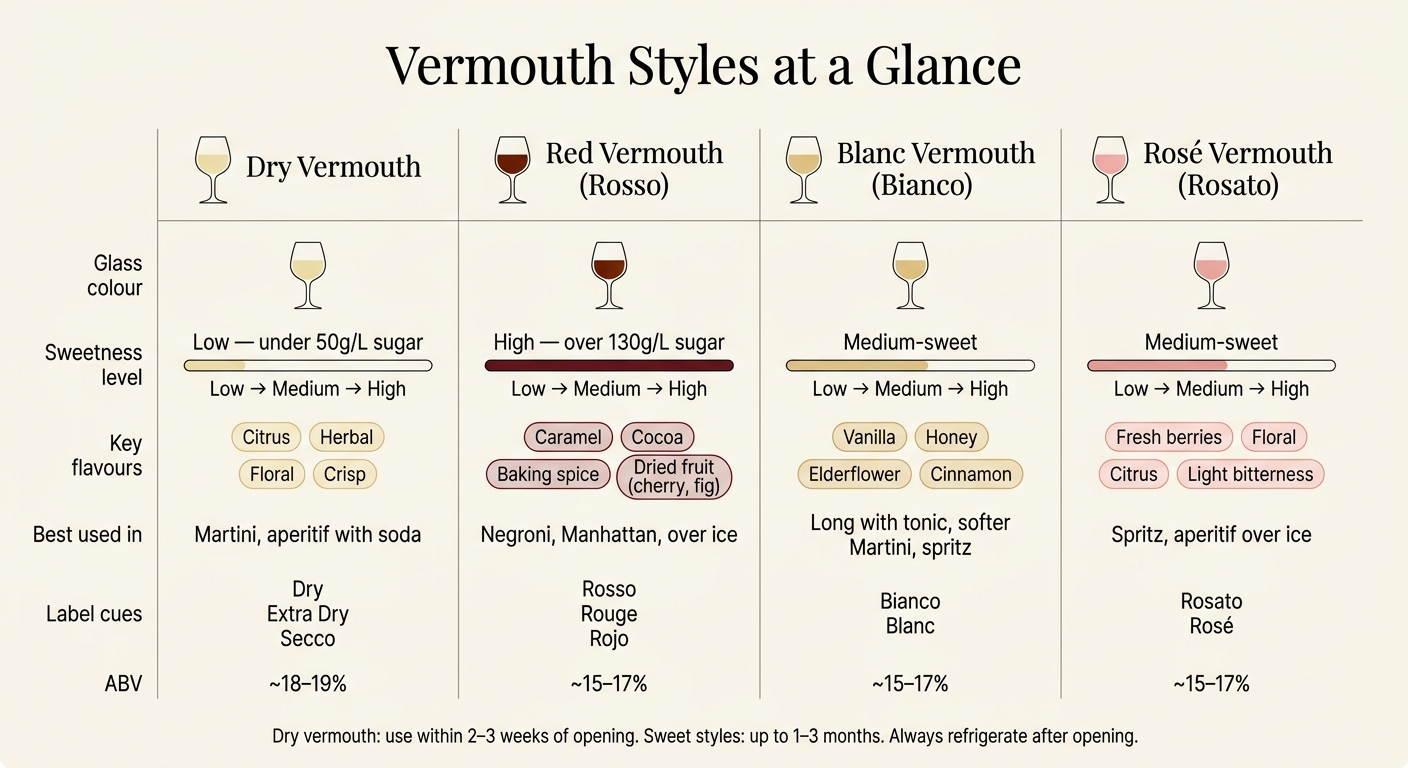
Vermouth Styles Compared: Dry, Red, Blanc & Rosé
Vermouth styles are mostly shaped by three things: sweetness, colour and botanicals. Once you know vermouth is a fortified aromatised wine, picking a bottle gets much easier. Start with the style, and you’ll have a solid idea of what’s in the glass.
Dry vermouth
Dry vermouth is pale and low in sugar, usually under 50g per litre. It tends to taste crisp, herbal and clean, with notes like citrus blossom, lemon peel and a very dry finish. Common botanicals include wormwood, bitter orange peel, nutmeg and coriander.
Red, blanc and rosé vermouth
Sweet vermouth styles differ mainly in sweetness, colour and the mix of botanicals.
Red vermouth (also called Rosso or sweet vermouth) is the richest sweet style. Sugar levels often go above 130g per litre. The flavour is deep and spiced, with caramel, cocoa, toffee, vanilla, baking spice and dried fruit notes such as cherry or fig. Its dark amber-red colour usually comes from caramelised sugar or caramel colouring, not red wine. Botanicals like clove, cinnamon, cardamom, gentian and rhubarb give it that warm, spiced character.
Blanc vermouth (bianco) sits between dry and red in sweetness. It’s pale gold, but quite a bit sweeter than dry vermouth, with soft vanilla, honeyed and floral notes. Elderflower, almond and cinnamon often show up in this style. If red vermouth feels a bit heavy and dry feels too sharp, blanc often lands nicely in the middle.
Rosé vermouth (rosato) is pink and is usually made from a blend of red and white wines. It leans fresh and berry-led, with floral notes, citrus and a light bitterness. In terms of sweetness, it sits between blanc and red styles.
Style comparison at a glance
| Style | Colour | Sweetness | Key flavour notes | Classic uses |
|---|---|---|---|---|
| Dry | Pale straw | Low (<50g/L) | Citrus, herbal, floral, crisp | Martini, aperitif with soda |
| Red (Rosso) | Dark amber/ruby | High (>130g/L) | Caramel, cocoa, baking spice, dried fruit | Negroni, Manhattan, over ice |
| Blanc (Bianco) | Pale gold | Medium-sweet | Vanilla, honey, elderflower, cinnamon | Long with tonic, softer Martini |
| Rosé | Pink | Medium-sweet | Fresh berries, floral, citrus, light bitterness | Spritz, aperitif over ice |
How vermouth is made
The style differences above start in the cellar, where the producer shapes the base wine, botanicals and sweetness.
Base wine, botanicals and infusion
Most vermouth begins with a neutral, high-acid white wine. That gives the botanicals a clean backdrop and stops the wine from getting in the way. Grapes such as Trebbiano, Catarratto, Picpoul and Clairette Blanche are often used. Some newer styles go in a different direction, using grapes like Bacchus for dry vermouth or Pinot Noir for red styles: our ESTATE, for example, is built on English Pinot Noir from Gusbourne in Kent.
Next comes the botanical infusion. Alongside the legally required wormwood (Artemisia), producers may use gentian root, cinchona bark, citrus peel, cardamom, cloves, chamomile, coriander and cinnamon. Some recipes include 30 to 50 botanicals. To get those flavours into the wine, producers usually macerate the botanicals or add tinctures and extracts.
Once that flavour base is in place, the producer adjusts the alcohol and sweetness to match the final style.
Fortification, sweetening and colour
Neutral spirit is added to lift the ABV and help stabilise the wine. It also helps the bottle keep for longer. In most cases, fortification brings the finished drink to about 16% to 18% ABV.
Sweetness is then set according to style. Producers may use sugar, grape must or caramel. Red vermouth also usually gets its colour from caramelised sugar and botanicals rather than from red wine.
Resting, ageing and bottling
After blending, vermouth needs time to settle. Resting helps the flavours come together, and oak ageing can add roundness while softening spice notes. After that, the blend is rested, sometimes aged in oak, then filtered and bottled.
How to read labels, store vermouth and choose the right bottle
Reading labels and spotting style cues
Once you know the main styles, the label does most of the work for you. It’s the fastest way to tell what’s in the bottle.
Rosso (Italian), Rouge (French) and Rojo (Spanish) all point to a sweet red style. Bianco (Italian) and Blanc (French) mean a sweet white. Dry, Extra Dry and Secco usually signal a pale style with less sugar. Under EU rules, Extra Dry must be under 30 g/L of residual sugar, while Dry must be under 50 g/L.
It’s also worth checking the ABV. Dry vermouth often lands at 18–19% ABV, which helps with flavour extraction and shelf life. Sweet styles tend to sit a bit lower, at 15–17%.
Some producers give you even more to go on. You might see botanicals or grape varieties on the label, such as English Bacchus grapes, rhubarb root or gorse flowers. That gives you a rough sense of the flavour before the cork is even out.
Storage and freshness after opening
Vermouth is wine-based, so once the bottle is open, treat it like white wine. Put it in the fridge straight away. If it sits at room temperature, it oxidises fast and starts to lose its aroma.
Dry vermouth is the most delicate style, so it’s best used within two to three weeks. Sweet Rosso and Bianco bottles last longer. Their higher sugar level gives them a bit more protection, and they can stay fresh for one to three months in the fridge.
If you only reach for vermouth now and then, a 375 ml bottle makes sense. There’s less air in the bottle after opening, which slows oxidation and helps it stay in better shape for longer.
Choosing a bottle for sipping or cocktails
It helps to match the style to how you plan to use it. Dry vermouth, such as our SCHOFIELD'S, suits Martinis and crisp aperitifs. Sweet vermouth, such as our ESTATE, fits Negronis and Manhattans. Blanc works well in spritzes and with soda, while rosé, such as our ROSÉ VERMOUTH, is a good pick for lighter summer serves.
Conclusion: the key points to remember
Vermouth is an aromatised fortified wine. In plain English, that means wine strengthened with neutral spirit and flavoured with wormwood (Artemisia) plus other botanicals.
From there, the style tells you a lot about how it will taste and how you might use it. Dry vermouth is lean, tart and herbaceous. Red (Rosso) styles are richer and spiced. Blanc is sweet but pale, with a floral, honeyed profile. Rosé is fruity and fresh, often with berry and citrus notes.
The finished bottle is shaped by the base wine, the botanicals, the level of sweetness and the colour.
That’s why the label is often your fastest guide. Once you know the cues (Rosso, Bianco, Dry and Extra Dry), picking the right bottle gets much easier. After opening, keep vermouth in the fridge and use it within one to three months.
FAQs
Is vermouth a wine or a spirit?
Vermouth is fortified wine, not a spirit. It begins with a base of neutral wine, and under European rules, that wine must account for at least 75% of the total volume.
The wine is then fortified with distilled spirit, aromatised with botanicals such as herbs, roots, bark and spices, and sweetened by different amounts. So yes, the alcohol level goes up, but vermouth is still a wine-based drink.
Why does vermouth need to be refrigerated?
Although vermouth is a fortified wine, it isn’t a spirit. That matters because once you open the bottle, it starts to oxidise and lose its flavour over time.
Pop it in the fridge after opening, and you’ll slow that process down. Stored this way, vermouth usually stays in good condition for up to two or three months.
Which vermouth style should I buy first?
It comes down to what you like and how you want to drink it.
- For a Negroni or Manhattan, go for sweet red vermouth (also called rosso or Italian vermouth), which is rich, spiced and full-bodied; our pick is ESTATE, an English sweet vermouth in the Italian rosso style.
- For a dry Martini or a glass served neat with a lemon twist, pick dry white vermouth, which is lighter and crisper; our pick is SCHOFIELD'S, an English dry vermouth with a floral nose and a clean citrus finish.
- If you want something a bit more flexible on the sweeter side, try bianco/blanc. It has floral, vanilla-led notes and works well over ice with soda.