



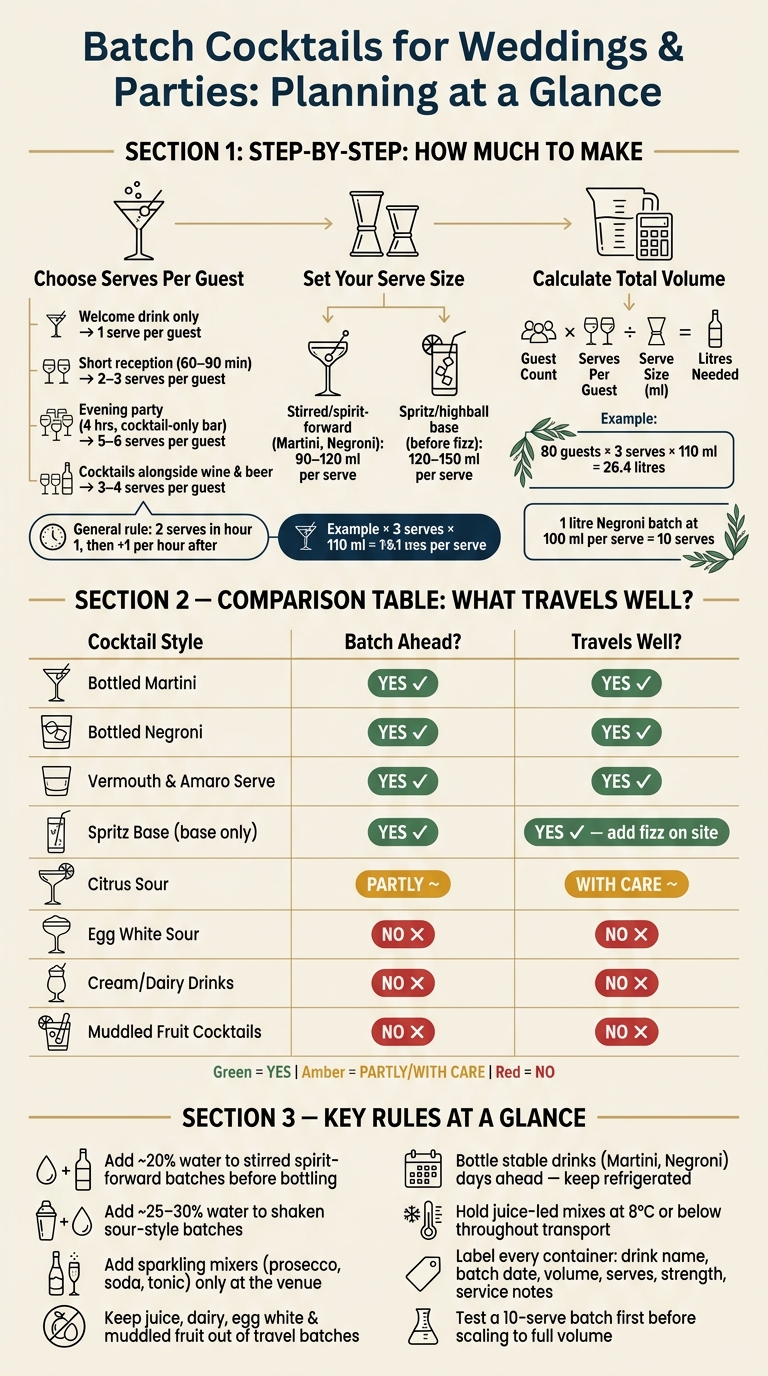
If you want batch cocktails to work, start with the maths. I’d plan 1 drink per guest for a welcome serve, 2 to 3 for a short reception, and 2 in the first hour plus 1 per hour after that for longer service. At 100 guests x 2 drinks x 130 ml, you need about 26 litres.
I reach first for SCHOFIELD'S, ESTATE and DISPENSE because vermouth-forward and stirred serves are the ones that hold up best once bottled, chilled and moved to site. Other bottles and styles can work too, but Martinis, Negronis, amaro-led drinks and spritz bases are usually the safest place to start.
Here’s the short version:
- Work out volume first: guest count x drinks per guest x serve size
- Use smaller serves for stirred drinks: about 90 to 120 ml
- Use larger base pours for spritzes: about 120 to 150 ml before fizz
- Add water to stirred batches: around 20% is a sound starting point
- Bottle stable drinks early: Martini, Negroni, vermouth-and-amaro serves
- Top spritzes at the venue: prosecco, soda and tonic should go in last
- Keep juice, dairy, egg white and muddled fruit out of travel batches
- Keep everything cold: juice-led mixes should stay at 8°C or below
A couple of figures help frame it. A 1-litre Negroni batch at 100 ml per serve gives about 10 serves. An 80-guest, 2-hour reception at 3 drinks each and 110 ml per drink comes to 26.4 litres. That is the sort of number worth knowing before you buy bottles, ice or storage tubs.
Batch Cocktails for Events: How Much to Make & What Travels Well
How to Batch Delicious Cocktails for a Party | The Cocktail Lab | America's Test Kitchen
Quick comparison
| Style | Batch ahead? | Travel well? | Notes |
|---|---|---|---|
| Bottled Martini | Yes | Yes | Best served cold, pre-diluted |
| Bottled Negroni | Yes | Yes | Steady in bottle and easy to pour |
| Vermouth and amaro serve | Yes | Yes | Good for short menus and fast service |
| Spritz base | Yes, base only | Yes | Add fizz on site |
| Citrus sour | Partly | With care | Add juice close to service |
| Egg white sour | No | No | Foam and food safety issues |
| Cream drinks | No | No | Can split in transit |
| Muddled fruit cocktails | No | No | Colour and flavour drop off fast |
If I were keeping the menu tight, I’d bottle one stirred serve with SCHOFIELD'S or ESTATE, build one bitter serve with DISPENSE, and offer one spritz base topped on arrival. That keeps the bar simple, cuts waste, and makes service smoother.
Work out how much cocktail to make
Choose a realistic serves-per-guest number
Once you have your guest count, turn that into a serve target, then into litres. That’s the bit that keeps you out of the weeds on the day.
A solid planning rule is 2 serves per guest in the first hour, then 1 serve per guest per hour after that. For most weddings and parties, that lands well. People usually start fast, then settle down.
For a short 60–90 minute drinks reception, plan for 2–3 serves per guest. That matters even more if cocktails are the only alcohol being served in that slot. For a 4-hour evening party with a cocktail-only bar, 5–6 serves per guest is a useful target. If cocktails are being served alongside wine, beer and soft drinks, many UK wedding caterers plan around 3–4 cocktail serves per guest, because the rest of the drinks list takes some of the pressure.
Convert guest numbers into litres
Once you’ve picked a serves-per-guest figure, the maths is simple:
Total serves = guest count × serves per guest
Total volume (ml) = total serves × single-serve size (ml)
Total volume (litres) = total volume (ml) ÷ 1,000
Serve size matters. Stirred drinks tend to be smaller; spritzes and highballs need more room.
For stirred, spirit-forward serves (Martinis, Negronis, vermouth-and-amaro drinks), use 90–120 ml per serve before ice. They’re stronger, so a shorter pour suits the drink. For spritz and highball bases, use 120–150 ml of base mix before ice and before any sparkling top-up. That usually gives you a finished serve of 200–250 ml.
Use these figures as a quick sense check before you scale the recipe:
| Event | Guests | Serves per guest | Single-serve size | Total batch volume |
|---|---|---|---|---|
| 2-hour cocktail reception | 80 | 3 | 110 ml (stirred) | 26.4 litres |
| 4-hour evening party (spritz base) | 120 | 4 | 130 ml (spritz base) | 62.4 litres |
A Negroni batch is a handy reference point. At 100 ml per serve, 1 litre gives 10 serves. It’s a neat yardstick when you’re scaling up.
Adjust for season, timing and serving style
Season shifts both the style of drink and the amount people get through. Summer garden receptions usually lean towards lower-ABV spritzes and vermouth-and-soda serves, and people often drink a bit more in warm weather. Adding 1 extra serve per guest against a similar indoor winter event is a sensible buffer.
Winter evening parties tend to suit bottled Martinis, Negronis and amaro-led stirred drinks. Total serves per guest can come in a little lower, especially if rich food and table wine are in the mix, but more of those serves will be spirit-forward. SCHOFIELD'S works well in pre-bottled Martinis, and DISPENSE brings depth to stirred batches.
Service format plays its part too. For summer spritzes, ESTATE makes a steady spritz base, then you can top with soda or sparkling wine at the venue.
With the batch size fixed, the next step is scaling the recipe with care and building in dilution.
Scale recipes accurately and plan dilution from the start
Multiply single-serve recipes in ml, then test a small batch first
Write each liquid ingredient in millilitres, then multiply by the number of serves. If one Martini uses 60 ml gin, 10 ml dry vermouth and 1 dash bitters, a 10-serve batch becomes 600 ml gin, 100 ml vermouth and 10 dashes bitters.
Start with a 10-serve test batch, chill it right down, and taste it before you make more. This is especially worth doing with bold ingredients such as SCHOFIELD'S, DISPENSE or a bittersweet aperitivo base, because they can show up a bit differently once you scale the recipe. If the balance needs work, change the spec there and then, and give the bar team one clear batch spec to use on the day.
Once the ratio is locked in, add dilution before bottling.
Add the right amount of water for the drink style
When you stir or shake a drink with ice, the melt water rounds off the alcohol and helps the flavour open up. With batching, you need to add that water yourself.
For stirred, spirit-forward drinks (Negronis, Martinis, vermouth-and-amaro serves), a good starting point is about 20% added water by total liquid volume. So a 1-litre batch of gin and vermouth would need about 200 ml of cold water stirred in before bottling. Higher-proof recipes may want more, while lighter, lower-proof serves may want less. Taste the batch once it is fully chilled, not at room temperature, because dilution reads very differently when the drink is cold.
Shaken sour-style drinks usually need more dilution, often about 25–30%.
| Drink style | Pre-dilution target | Use |
|---|---|---|
| Stirred spirit-forward (Negroni, Martini) | ~20% of total volume | Taste cold; adjust in small steps |
| Shaken sour-style | ~25–30% of total volume | Shaking adds more dilution than stirring |
| Spritz or highball base | Minimal to none | Carbonated mixer does the dilution at service |
Batch stable ingredients early and add fresh elements at service
Batch the stable core, then add anything fresh at service. Spirits, vermouths, amaro, aperitivo, syrups and bitters can all be combined days ahead. That means SCHOFIELD'S, ESTATE, DISPENSE and ASTERLEY ORIGINAL can all go into the batch early, as long as the batch stays refrigerated.
Fresh citrus drops off fast, fizzy mixers lose their sparkle, and egg white loses the structure that gives a drink its foam. Add those as close to service as you can: ideally at the venue, not the night before. If the recipe depends on citrus, batch everything else first, then squeeze and add the juice shortly before service begins.
That split, a stable base and a fresh finish, is what helps a pre-batched cocktail taste like it has just been made. With the base scaled and diluted, the next step is choosing formats that travel well.
Choose cocktail styles that hold up in transit
Bottle stirred drinks: Martinis, Negronis and spirit-forward serves
Once you've scaled the batch and added dilution, the next job is simple: pick drinks that still taste right after the journey. Stirred, spirit-forward serves are the safest bet for a portable bar. They have no fresh juice, dairy or carbonation, so they stay balanced when kept cold in sealed bottles.
A Martini, Negroni or gin-and-amaro serve can all be bottled a few days before the event and held cold until service. SCHOFIELD'S sits neatly in a bottled Martini. ESTATE suits a Negroni-style build. DISPENSE, paired with gin or whisky, makes a ready-to-pour aperitif-style serve that still drinks well after a short spell in bottle or on ice. All three travel well and pour cleanly at the venue with very little kit.
Prepare spritz and highball bases, then top at the venue
With spritzes and highballs, batch the still base only. Prosecco, soda or tonic needs to go in at service. The base can travel; the sparkle cannot.
For a lighter daytime spritz, mix SCHOFIELD'S and ASTERLEY ORIGINAL in a 2:1 ratio as your still base, then pour 50 ml over ice and top with 75–100 ml chilled prosecco at the venue. For an evening reception, or for colder months, ESTATE with a measure of DISPENSE gives you a darker, bittersweet base that works well with soda or tonic. Move the still base in sealed bottles kept cold, and keep sparkling mixers chilled in their original packaging.
Two bases are usually enough: one light and citrus-led, one more bitter and aromatic. That gives guests a clear choice without turning the bar into a juggling act. From there, it comes down to the bottle, the temperature and how you'll pour on site.
Formats to avoid when pre-batching for a portable bar
Some drinks are more trouble than they're worth once transport is part of the plan. Egg white, cream, muddled fruit and fully mixed citrus drinks all bring risks that stirred and vermouth-forward serves neatly sidestep. Citrus-led cocktails are the awkward middle ground. If you want one on the menu, keep the spirit base separate and add the juice at service. Even then, they are less dependable than stirred or vermouth-forward drinks and should not carry a portable bar.
| Format | Travels? | Main issue |
|---|---|---|
| Bottled Martini / Negroni / spirit-forward stirred | Yes | Stable and consistent when chilled |
| Spritz / highball (still base only) | Yes | Add sparkling mixer at service only |
| Citrus sours (juice added at service) | With care | Juice degrades; keep citrus close to service |
| Egg white sours | No | Foam collapses; food safety risk |
| Cream / dairy drinks | No | Separates; difficult to manage in transit |
| Muddled fruit cocktails | No | Oxidises quickly; bitter and discoloured |
Next comes container choice and cold holding.
Store, transport and serve the batch safely
Use the right containers and keep everything cold
Once the batch is mixed, storage does a lot of the heavy lifting. The right container helps the drink stay clean in flavour, and the cold chain helps it pour as it should.
Use sealed glass bottles for bottled stirred serves, and lidded, food-safe containers for larger still batches. Glass is flavour-neutral and helps limit oxidation when you leave as little headspace as possible. Flip-top or capped bottles are a good fit for single portions. Larger bottles or covered dispensers make sense for poured service.
Chill the batch before transport. Then keep it in an insulated cool box with ice packs, and hold any drink with juice or fruit at 8 °C or below.
Label every container clearly with:
- drink name
- batch date
- volume
- serves
- strength
- service notes
Match the service format to the event
After storage, think about service. Bottle what stays stable. Pour what needs topping or mixing on site.
Pre-bottled single serves are the fastest route for welcome drinks. Chill them in advance, hand them out as guests arrive, and the bar team does not need to measure a thing. For a staffed bar with a short cocktail menu, labelled bottles poured to order give you more control. A spritz base topped at service works well for longer receptions, when guests want something cold, light and fizzy.
A hybrid setup often works best: bottled welcome cocktails first, then a simple two- or three-drink bar menu to keep service fast and waste low.
Decide on glassware before batching. A 125 ml coupe gives you more serves than a 200 ml tumbler.
Check venue rules and get batching support where needed
Venue rules can be all over the place, so pin them down early. Before the event, check whether the venue allows outside alcohol, what corkage fees apply, whether fridge or ice storage is available on site, and whether their own staff must do the pouring. Some UK wedding venues limit outside drinks or charge corkage per bottle, so get the rules in writing before the day.
If the event starts to feel a bit big for a DIY batch, there is a shortcut for the Negronis: RHUBARB NEGRONI comes ready-bottled, built on ESTATE, so it only needs ice and a glass on the day. For larger volumes of any of our bottles, talk to the Asterley Bros trade team.
Conclusion: Simple maths, stable serves and good preparation
Batching gets much easier when you start with serves per guest. A good rule is two drinks in the first hour, then one drink for each hour after that. Multiply that by your guest count, then by your serve size in millilitres, and you have the total volume you need to batch and buy.
Scale recipes in millilitres and litres, not vague parts, and build dilution into stirred serves from the start. Before you scale up, test 5–10 serves. It is a small step, but it can save a lot of waste and stress later.
Once the batch is scaled and diluted, pick formats that travel cleanly and pour fast. Bottled Martinis made with SCHOFIELD'S, Negroni-style serves built with ESTATE and DISPENSE, and spritz bases built on ASTERLEY ORIGINAL all make sense here. Top spritzes at the venue with chilled prosecco or soda. They travel well and ask less of your kit on the day.
From there, it comes down to cold storage and the right containers. Keep everything cold in sealed, food-safe, clearly labelled containers. Match serve size to glassware before you batch. Check venue rules on pre-batched alcohol, refrigeration, storage space and container types. For larger events, talk to the Asterley Bros trade team.
Clear numbers, steady formats and cold storage keep service smooth.
FAQs
How much extra should I batch as a buffer?
Plan an extra 10% to 15% as a buffer for thirsty guests and the odd spillage. It takes the pressure off and helps you avoid running dry, especially if you are serving crowd-pleasers like Negronis or Martinis.
For a steadier pour every time, pre-chill your ingredients and storage vessels. If you have any batched cocktails left over that contain vermouth, keep them in the fridge so they stay fresh for the next gathering.
How far in advance can I make bottled cocktails?
You can usually make and bottle batch cocktails ahead of time, especially if they contain vermouth, so long as you keep them in the fridge.
Vermouth is wine-based, which means it is prone to oxidation once opened. Keep it chilled, seal the bottle or container tightly, and aim to use it within about a month while those delicate botanical notes are still in good shape.
What glassware should I choose for batch cocktails?
Match the glassware to the way the drink is served. It sounds like a small detail, but it changes the feel of the whole pour.
- Coupe or Nick and Nora for cocktails served up, such as stirred Martinis or Manhattans.
- Tumbler for drinks served over ice.
- Highball for longer, fizzy drinks.
Pop your glasses in the freezer for 10 minutes before serving. That little bit of chill helps keep cocktails properly cold from first sip to last.