



Pre-batching martinis is a simple way to save time and ensure consistent quality for your cocktails. By mixing gin, vermouth, and water in advance, you can store the batch in the freezer and serve perfectly chilled martinis whenever needed. Here's the process in a nutshell:
- Ingredients: Use a 6:1 ratio of gin to vermouth, plus 20–25% water for dilution.
- Preparation: Combine the ingredients, stir thoroughly, and bottle the mixture.
- Freezing: Store the batch in the freezer for 4–6 hours or overnight for the best texture and flavour.
- Serving: Pour directly into pre-chilled glasses and garnish with a lemon twist.
This method delivers martinis that are smoother, colder, and more balanced than those made on the spot. It's ideal for hosting, surprise guests, or simply enjoying a no-fuss cocktail at home.
The Best Batched Martini: Step By Step Guide To The Perfect 'Freezer Door' Cocktail
Ingredients and Proportions
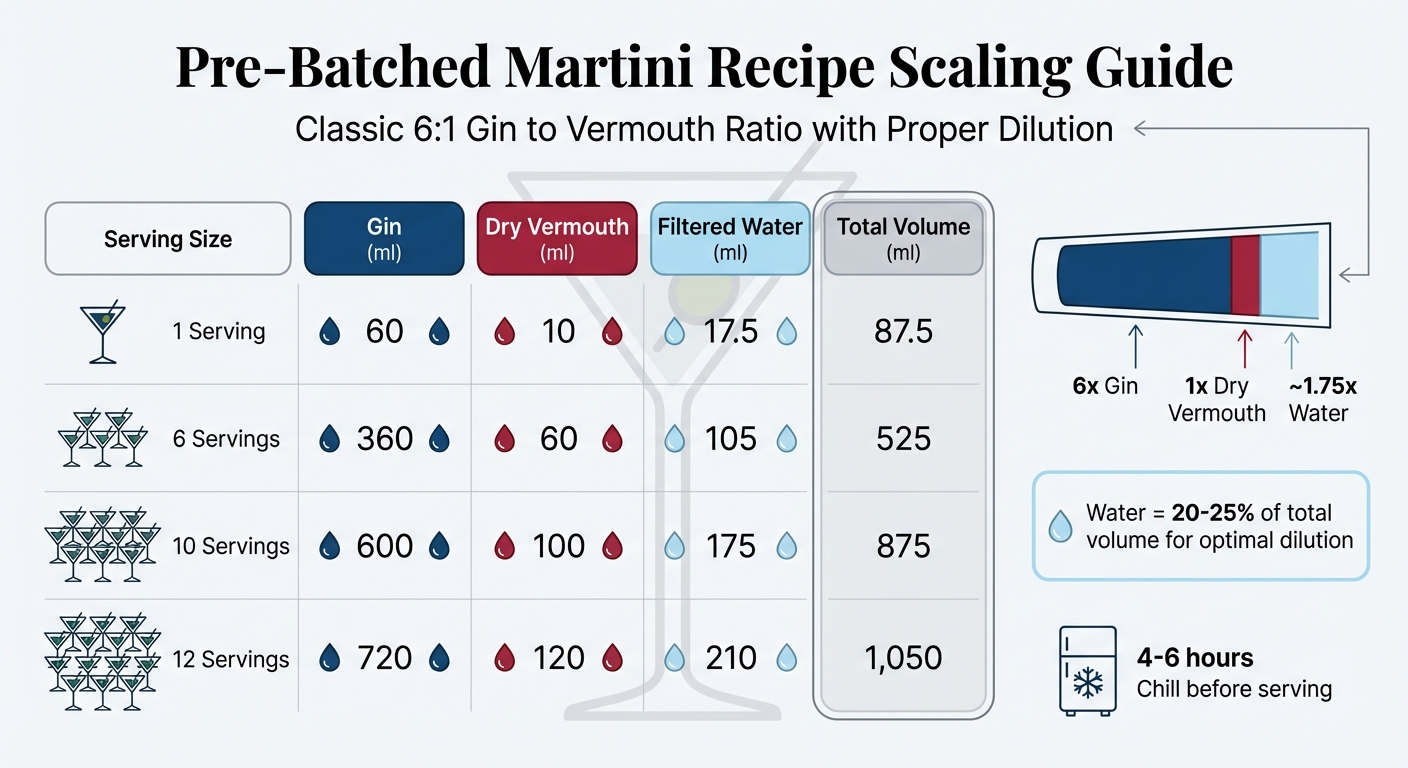
Pre-Batched Martini Recipe Scaling Guide: Ingredient Ratios for 1-12 Servings
Getting the proportions right is the secret to a perfect pre-batched martini. The classic dry martini sticks to a 6:1 ratio of gin to vermouth, offering a well-balanced and aromatic blend when paired with SCHOFIELD'S English dry vermouth (Gold, World Vermouth Awards 2021; 2 stars, Great Taste 2020), made with the Schofield brothers.
Classic Martini Ratios
For a single serving, you'll need 60ml of gin, 10ml of dry vermouth, and 17.5ml of filtered water. That last ingredient mimics the dilution you'd normally get from stirring with ice. As Candra Drinks puts it:
"Water lowers the strength of a Dry Martini, unlocking all the flavours carried in the alcohol, bringing all the Gin's botanicals to the forefront."
When it comes to pre-batched martinis, SCHOFIELD'S Dry Vermouth stands out. With 28 botanicals, a floral nose and a clean citrus finish, its botanical complexity mellows and blends over time, resulting in a more cohesive drink compared to one made à la minute.
Scaling Recipes for Multiple Servings
Planning for a crowd? Scaling the recipe is straightforward. For 10 servings, combine 600ml of gin, 100ml of dry vermouth, and 175ml of filtered water. This will yield 875ml, which fits neatly into a 1-litre glass bottle. For a 12-serving batch, use 720ml of gin, 120ml of dry vermouth, and 210ml of water, giving you a total of 1,050ml.
| Serving Size | Gin (ml) | Dry Vermouth (ml) | Filtered Water (ml) | Total Volume (ml) |
|---|---|---|---|---|
| Per Serving | 60 | 10 | 17.5 | 87.5 |
| 6 Servings | 360 | 60 | 105 | 525 |
| 10 Servings | 600 | 100 | 175 | 875 |
| 12 Servings | 720 | 120 | 210 | 1,050 |
Understanding Dilution
In a stirred martini, dilution typically makes up 25% to 30% of the total volume. By adding filtered water to your pre-batched mix, you can replicate this process with precision, ensuring you have full control over the drink's strength and texture. After chilling the mixture in the freezer for 4–6 hours, you'll end up with a silky, velvety martini that pours like cream and stays colder for much longer than one made fresh.
Tools and Equipment Needed
Getting your equipment ready beforehand makes the process much smoother. The best part? You probably already have most of what you need in your kitchen or bar.
Required Equipment
Start with measuring tools. A jigger or liquid measuring cup is great for measuring out gin and vermouth, but for precision, especially when it comes to dilution, a digital scale is invaluable. To figure out how much water to add to your batch, weigh a single cocktail before and after stirring it with ice: the difference is the amount of water you’ll need per serving. Bartender and author John deBary offers this helpful tip:
"Measure everything into separate vessels and then combine at the last step. This ensures you actually have all of what you need, plus it gives you an added layer of security if you flub a measurement."
You’ll also need a large mixing bowl or jug to combine your ingredients before bottling. For smaller batches, a 700 ml mixing glass works well. To avoid spills when transferring your mixture into bottles, use a funnel.
Once you’ve got your measuring tools and mixing vessel sorted, it’s time to think about the best storage containers for your batch.
Storage Containers
Picking the right storage container is crucial for preserving the flavour. Glass bottles are the way to go, as plastic containers can absorb flavours, potentially leaving them with a permanent gin aroma. Glass spirit bottles (750 ml) with screw caps or swing-top closures are ideal. They provide airtight seals, are reusable, and won’t interfere with the taste of your batch. Bartender Al Culliton recommends:
"The best kind are bottles that have flip-tops (they have myriad uses and you'll never lose the cap), but any leftover bottle kicking it in your recycling bin (and washed!) that has a screw cap will work in a pinch."
Whichever type of bottle you choose, ensure it’s thoroughly cleaned and sterilised before use. Don’t forget to label your bottles with the contents and the date for easy identification.
How to Pre-Batch Martinis
With your equipment and containers ready, it’s time to tackle the batch itself. The process is simple, but precision is key, especially when managing dilution.
Mixing the Batch
For a 10-serving batch, measure out 600 ml of gin, 100 ml of dry vermouth, and 175 ml of filtered water, then combine them in a large mixing bowl. The filtered water acts as a substitute for the dilution you'd typically get from ice. As Rafa García Febles, Beverage Director at Hav + Mar, puts it:
"Dilution reshapes the flavour profile, so it's an important step."
Stick to standard dilution ratios, but feel free to tweak slightly for higher-ABV drinks. If you’re adding bitters, use only half the usual amount, as they tend to intensify in large batches, and you can always adjust later. Once everything is measured, stir the mixture thoroughly to ensure it’s well blended. Then, use a funnel to transfer the liquid into clean glass bottles. This careful mixing ensures a consistent, high-quality martini every time.
Storing in the Freezer
After mixing, the next step is to chill the batch quickly. Seal the bottles and place them in the freezer for 4–6 hours, or overnight for best results. Freezing gives the martini a rich, almost creamy texture that you wouldn’t get from stirring with ice. M. Carrie Allan, Spirits Columnist at The Washington Post, describes it perfectly:
"And the drink gets so cold in the freezer, it pours almost like cream: a thick, arctic sip of boozy goodness."
Set your freezer temperature between -12°C and -10°C (10°F to 14°F). If you notice ice crystals forming (common with vermouth-heavy ratios like a 50/50 martini), move the bottle to the fridge to prevent it from freezing solid. Spirit-forward batches can stay in the freezer for weeks, with their flavours continuing to blend and improve over time.
Serving Your Pre-Batched Martinis
Once your batch is perfectly chilled, serving is a breeze. Pre-chill your martini glasses in the freezer to keep the drink icy cold when poured. Take the bottle straight from the freezer and pour the martini directly into the pre-chilled glasses: it’s already at the ideal dilution and temperature. Add a garnish of lemon twist just before serving, squeezing its citrus oils over the drink for a fragrant finish. The result? A flawless martini with minimal effort, so you can focus on enjoying the moment with your guests.
Martini Variations and Customisation
Once you've mastered pre-batching, it’s time to dive into customised martini variations that can transform your cocktail game. By experimenting with different gins, vermouths, and even aperitifs, you can craft martinis with distinct personalities. Whether you’re aiming for crisp and herbal or rich and bittersweet, these options let you refine your drink to suit any occasion.
Botanical Martini Options
For a crisp and herbal martini, try pairing a botanical gin with SCHOFIELD'S Dry Vermouth. This combination delivers a clean profile with subtle herbal undertones. If you’re in the mood for something richer, swap the dry vermouth for ESTATE Sweet Vermouth. This creates a rounder and more balanced flavour, complementing the gin's botanicals beautifully.
When pre-batching these variations, tweak the dilution slightly. For the dry version, use 1.25 oz (37 ml) of filtered water per serving. For the sweeter mix, reduce the dilution to 1.0 oz (30 ml). These adjustments follow the same principles of controlled dilution discussed earlier.
Freezing these pre-batched botanical martinis enhances their texture, making them "more lush and creamy" while softening the sharper edges of high-proof spirits. This process also allows the delicate herbal and floral notes to take centre stage. If you’re looking for a different spin, try incorporating an aperitivo for a bittersweet twist.
Using ASTERLEY ORIGINAL
For an aperitivo-style martini, substitute half of the dry vermouth with ASTERLEY ORIGINAL, our British aperitivo. This tweak adds a fruity and bittersweet complexity to the cocktail. To ensure the batch doesn’t freeze solid (the aperitivo has a lower alcohol content), use 0.75 oz (22 ml) of filtered water per serving. This slightly reduced dilution keeps the texture just right.
If you want to enhance the citrus notes, consider adding a few dashes of orange bitters to the batch. But go easy: bitters intensify over time, and a little goes a long way. The result? A sophisticated martini with evolving flavours, perfect for those who enjoy a touch of complexity in their cocktails.
Summary
Main Points to Remember
Pre-batching martinis simplifies cocktail preparation while ensuring perfect ratios, balanced dilution, and ideal freezer storage. The process hinges on three essentials: scaling your recipe accurately, adding just the right amount of water to replicate ice melt, and freezing the batch for at least 4–6 hours. This freezer time enhances the texture, giving it a smooth finish, while also amplifying the flavours of the botanicals.
Whether you stick to the classic dry vermouth for a sharp, clean taste or experiment with something like ASTERLEY ORIGINAL for a touch of bittersweet complexity, using high-quality ingredients is the key to consistently elegant results. Keep these fundamentals in mind as you refine your pre-batched martini technique.
Tips for Best Results
- Use filtered water for dilution to maintain the pure flavours of your gin and vermouth.
- Chill your serving glasses along with the batch to keep everything at the perfect temperature.
- A 750 ml bottle is perfect for six servings, making it convenient for entertaining.
For an aromatic boost, garnish with a fresh citrus twist. Before pouring, give the bottle a gentle swirl to ensure the ingredients are evenly mixed. Serving in smaller 3–4 oz glasses is a smart move, as it encourages guests to enjoy their martinis while they’re still perfectly chilled.
As Hamilton-Mudge aptly puts it:
"Time spent in the bottle will only soften and round your Martini, in the same way flavours further integrate during slow cooking."
FAQs
What is the best gin-to-vermouth ratio for pre-batching martinis?
When it comes to pre-batching martinis, five or six parts gin to one part dry vermouth, such as SCHOFIELD'S, is the classic choice; this guide uses 6:1 (60ml gin to 10ml dry vermouth). This proportion delivers that quintessential dry martini taste, offering a smooth and refined flavour.
If you're scaling up to serve a crowd, precise measurements are key to keeping the balance just right. Feel free to tweak the ratio slightly if you prefer a different taste. Once mixed, store your batch in the fridge or keep it over ice to ensure it stays fresh and perfectly chilled for serving.
How long can you store pre-batched martinis in the freezer?
Pre-batched martinis can be kept in the freezer for a minimum of 4 hours before serving and remain fresh for as long as 2 months. To maintain their flavour and keep out any unwanted freezer odours, make sure the bottle is sealed tightly.
When you're ready to serve, give the bottle a gentle shake. This helps ensure the ingredients are evenly blended and the drink is perfectly chilled.
Can I personalise pre-batched martinis with different flavours?
Of course! You can easily customise your pre-batched martinis by introducing extra flavours before bottling and freezing. Try adding botanicals, bitters, or brines to elevate the drink’s character: perhaps a splash of rose water for a floral touch, spicy bitters for a bit of heat, or olive brine to create a dirty martini vibe.
Feel free to experiment with subtle tweaks to match your taste or impress your guests. Just make sure the flavours harmonise with the base ingredients for a polished and refined result.