



We start a wetter Martini with 50 ml gin and 25 ml vermouth, a 2:1 ratio. It keeps gin in the lead while giving vermouth’s floral, herbal and citrus notes more room.
Our pick is SCHOFIELD'S DRY VERMOUTH, made with an English white-wine base. We reach for it for its floral aromas and bright citrus finish. Other dry vermouths work too, but we use the same bottle and gin throughout to taste what the ratio changes.
Quick comparison
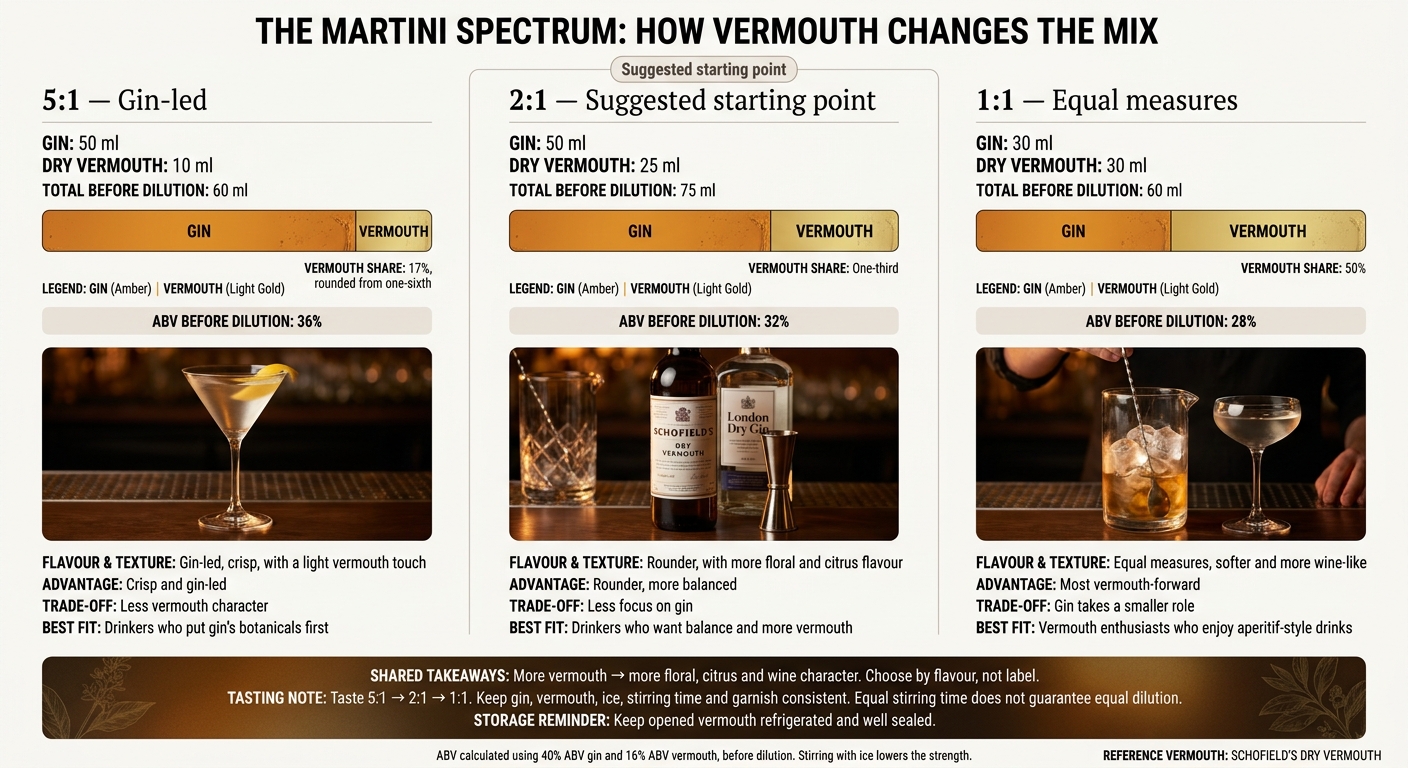
| Gin to vermouth | Measures | Flavour and texture | ABV before dilution* |
|---|---|---|---|
| 5:1 | 50 ml + 10 ml | Gin-led, crisp, with a light vermouth touch | 36% |
| 2:1 | 50 ml + 25 ml | Rounder, with more floral and citrus flavour | 32% |
| 1:1 | 30 ml + 30 ml | Equal measures, softer and more wine-like | 28% |
Calculated using 40% ABV gin and 16% ABV vermouth. Stirring with ice lowers the strength.
We taste from 5:1 to 2:1 to 1:1, keeping the ice, stirring time and garnish the same. <u>Equal stirring time does not mean equal dilution</u>, so check each drink before judging its balance. Keep opened vermouth refrigerated and well sealed, then choose the ratio you enjoy most.
Martini Ratios: 5:1 vs 2:1 vs 1:1
1. 5:1 Martini - 50 ml Gin and 10 ml Vermouth
Aroma and Botanical Flavour
At 5:1, gin leads, with SCHOFIELD’S adding rose, camomile, jasmine, rosemary and gentian in the background.[2][3] Taste it before adding a garnish to pick out what those 10 ml of vermouth bring to the glass.
Texture
Vermouth makes up 17% of the mix before dilution, keeping the drink gin-led.[6][7] Stir with plenty of newly made ice for around 20–30 seconds, then strain into a chilled glass. Water from the melting ice softens the alcohol’s edge while keeping the finish crisp.
Alcohol Strength
Using 40% ABV gin and SCHOFIELD’S at 16% ABV gives approximately 36% ABV before dilution.[6][7] Stirring brings that down further; how far depends on how much water the ice adds.
Balance
Look for recognisable gin botanicals, a little wine-based acidity and a clean finish. If the alcohol tastes hot, chill the drink for longer before changing the ratio. If it’s properly chilled but still tastes one-dimensional, try more vermouth.
For a less dry drink with more vermouth weight, move to 2:1. Make this version with SCHOFIELD’S DRY VERMOUTH from the Asterley Bros shop.
sbb-itb-f74956d
2. 2:1 Martini - 50 ml Gin and 25 ml Vermouth
Aroma and Botanical Flavour
Compared with 5:1, a 2:1 Martini gives vermouth’s botanicals more room while keeping gin in the lead. Mix 50 ml gin with 25 ml SCHOFIELD’S DRY VERMOUTH and you’ll taste its white-flower and citrus notes alongside the gin.[9][10][2] SCHOFIELD’S DRY VERMOUTH is available from the Asterley Bros online shop.
Texture
The vermouth rounds out the mouthfeel without making the drink thick or syrupy. Stir with hard ice until thoroughly chilled, but avoid too much meltwater: it can leave the Martini tasting thin.[8]
Alcohol Strength
A 2:1 Martini is roughly 33% ABV before dilution, with a less sharp taste than a drier serve.[9]
Balance
Try it beside a 5:1 Martini, keeping the ice and garnish the same. Juniper should come first, followed by clearer wine character and brighter floral-citrus notes. It sits between a gin-led and a vermouth-led drink. If 25 ml gives the vermouth too much say, reduce it to 15 ml.[12][13] For a more pronounced vermouth flavour, move on to 1:1.
3. 1:1 Martini - 30 ml Gin and 30 ml Vermouth
Aroma and Botanical Flavour
At 1:1, vermouth shares the stage with gin rather than playing a supporting role. Use 30 ml gin and 30 ml SCHOFIELD’S DRY VERMOUTH. That makes vermouth half the mix before dilution, up from a third at 2:1. Its 28 botanicals, including camomile, rose, rosemary and cardamom, give floral, herbal and spiced notes more room alongside the gin.[6][11]
Texture
Expect a softer, more wine-like drink than either gin-heavy ratio. Stir with newly made ice for 20–30 seconds, then strain into a chilled Martini or Nick & Nora glass. Ice size and temperature affect how much water enters the drink.
Alcohol Strength
With a 40% ABV gin and 16% ABV SCHOFIELD’S, the 60 ml mix contains 16.8 ml of pure alcohol. That puts it at 28% ABV before dilution; stirring with ice lowers it further.[6]
Balance
Choose a full-bodied, juniper-led gin that can hold its own against an equal measure of vermouth. If the drink tastes too wine-forward, return to 50 ml gin with 25 ml vermouth.
Keep SCHOFIELD’S refrigerated after opening; at 1:1, the condition of the vermouth matters most. You can buy SCHOFIELD’S from the Asterley Bros online shop. With the ratio set, pay attention to stirring and dilution: both shape the finished Martini.
How to make a MARTINI. Classic vs Modern
How to Mix and Taste Each Ratio
Compare the three ratios under the same conditions so you can judge vermouth’s effect. Chill the serving glass with ice and water while you measure. Build each Martini with Asterley Bros SCHOFIELD’S DRY VERMOUTH in a separate mixing glass with hard ice. Keep the ice, stir time and garnish the same, and empty the serving glass before straining. Leave every sample ungarnished, or use the same garnish throughout: lemon adds citrus aroma; an olive adds salt and savoury flavour.
Stir, don’t shake, to keep the texture comparable. Stir for 25–30 seconds, then taste. Strain once the drink is cold and lightly diluted.[14][15] If it tastes too concentrated, stir a little longer; if it tastes thin, shorten the next stir.
Equal stir time does not guarantee equal dilution. The 5:1 and 1:1 recipes each total 60 ml, while 2:1 totals 75 ml. Check dilution before putting changes in botanical flavour down to the vermouth.[4]
Taste from driest to wettest: 5:1 → 2:1 → 1:1. This lets you taste how vermouth brings the botanicals forward. Sip still water between samples and taste each before it warms. Note how the vermouth changes juniper, floral notes, citrus, bitterness and balance.
Which Martini Ratio Suits You?
Choose by flavour, not label. Taste the three ratios side by side with SCHOFIELD’S DRY VERMOUTH as your reference, then pick the one that suits your palate.[2][9][5]
The comparison below shows how each ratio changes the flavour, texture and weight of vermouth in your glass.
| Ratio and measure | Advantage | Trade-off | Best fit |
|---|---|---|---|
| 5:1: 50 ml gin + 10 ml vermouth | Crisp and gin-led | Less vermouth character | Drinkers who put gin’s botanicals first |
| 2:1: 50 ml gin + 25 ml vermouth | Rounder, more balanced | Less focus on gin | Drinkers who want balance and more vermouth |
| 1:1: 30 ml gin + 30 ml vermouth | Most vermouth-forward | Gin takes a smaller role | Vermouth enthusiasts who enjoy aperitif-style drinks |
For a simple starting point, try 2:1.[9][5]
Buy SCHOFIELD’S from the Asterley Bros online shop to mix your preferred ratio at home.
Start with 2:1 and SCHOFIELD’S
Begin with 50 ml gin and 25 ml Asterley Bros SCHOFIELD’S DRY VERMOUTH for a clear 2:1 starting point.[5]
Keep the vermouth refrigerated and well sealed. An oxidised bottle will flatten the Martini, even when the ratio is right.[16]
To make your preferred wetter ratio, use SCHOFIELD’S DRY VERMOUTH from the Asterley Bros online shop.
FAQs
Does a wetter Martini taste sweeter?
Yes - a wetter dry Martini usually tastes less dry and more rounded. More vermouth brings its flavour and any residual sweetness to the fore. At 2:1 gin to vermouth, rather than 5:1, the drink moves away from gin-led briskness towards a softer taste with more vermouth character.
How can I tell if my Martini is over-diluted?
A Martini should taste crisp, not muddy or flat. If yours doesn’t, it may be over-diluted or out of balance. Heavy, sweet vermouth can make it cloying, while too much vermouth can overwhelm the botanicals. A bottle kept warm or left open too long can oxidise, dulling its aroma [1].
Aim for a wetter gin-to-vermouth ratio of 2:1 or 3:1, measuring carefully to keep the balance under control. Use cold vermouth from a newly opened bottle, and keep it in the fridge [1].
How long does opened SCHOFIELD’S DRY VERMOUTH stay fresh?
Once opened, keep SCHOFIELD’S DRY VERMOUTH in the fridge to retain its botanical character. It stays drinkable for up to one or two months, but use it within three to four weeks for the brightest, crispest flavour.
Like any wine-based drink, it oxidises over time when left at room temperature. That’s the most common reason a Martini made at home tastes flat.