



AI is transforming the way we create, personalise, and experience drinks - from crafting botanical spirits to recommending cocktails tailored to your taste. By analysing data and trends, AI is helping brands predict what you’ll want to drink next, develop products faster, and improve quality. Here’s what you need to know:
- Personalised recommendations: Tools like Diageo’s Flavourprint match your flavour preferences with drinks in seconds.
- Faster product development: AI shortens the time to create new drinks by analysing trends and testing combinations digitally.
- Enhanced home bar experiences: Smart apps suggest cocktails based on your ingredients, mood, or even the weather.
- Improved quality control: AI ensures consistency in production and reduces waste, even in complex botanical blends.
- Consumer demand: 76% of people believe AI will influence their alcohol choices in the next five years.
While AI handles data and precision, human expertise remains essential for perfecting recipes and maintaining the artistry behind each drink. This partnership is reshaping how we drink, blending technology with craftsmanship to offer more tailored, efficient, and high-quality experiences.
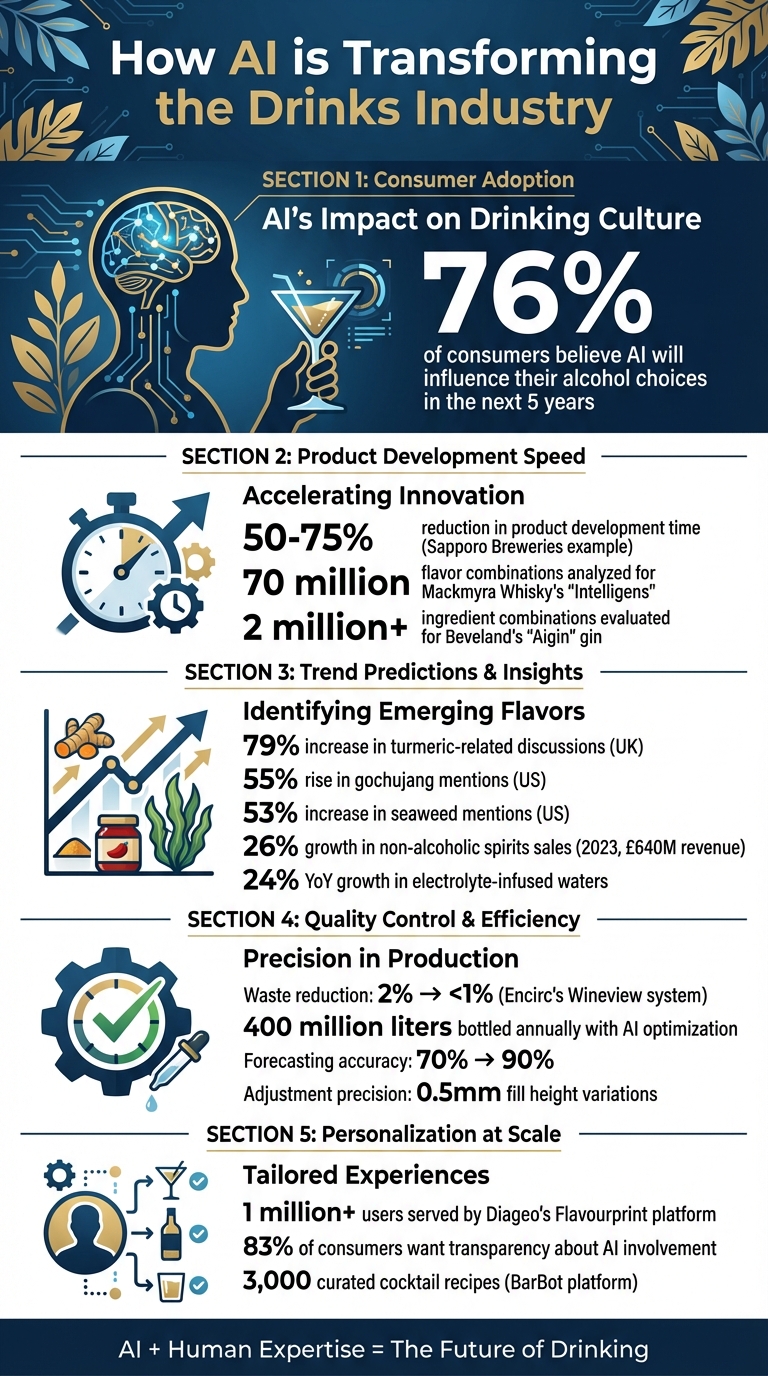
How AI is Transforming the Drinks Industry: Key Statistics and Applications
How AI Changes Product Development
Using AI to Predict What Consumers Want
AI is transforming how brands anticipate consumer preferences by analysing data from sources like social media, news outlets, menus, and bar offerings. This allows companies to identify emerging flavour trends on national, regional, and global scales. Instead of simply reacting to trends, brands can now proactively develop products based on predictive insights.
In June 2024, Diageo's Breakthrough Innovation Team joined forces with Singapore-based startup Ai Palette to produce a "Flavour Forecast" report. This AI-powered tool sifted through web data, social media conversations, and global menu offerings to highlight five dominant trends for the season: umami universe, spicy spark, tropical takeover, treating temptation, and bloom harvest. The report uncovered specific patterns, such as a 79% increase in turmeric-related discussions and an 18% rise in guava mentions within the UK. Diageo's Chief Innovation Officer, Mark Sandys, emphasised the importance of this forward-thinking strategy:
"We're looking for the big macro trends consumers are going to care about in five to 10 years' time, so that we can work back from them to create propositions so that – by the time that trend materialises – we are ready."
This approach is particularly useful for aged spirits, which require years to mature. Meanwhile, botanical spirits and aperitifs can be developed much more quickly. AI has also detected growing interest in Asian-inspired cocktail flavours in the US, with mentions of gochujang up by 55%, seaweed by 53%, and tahini by 45%. These insights are reshaping the way brands approach product innovation, offering a precise roadmap for future developments.
Developing Products Based on Trend Data
Armed with these insights, brands can tailor products to suit local preferences and demographic needs. Predictive modelling enables producers to digitally refine flavour profiles, test combinations, and adjust formulations before committing to full-scale production. This method has been especially impactful in the functional beverage market, where AI identified a 24% year-over-year growth in electrolyte-infused waters and a 26% rise in demand for collagen-infused drinks.
AI-driven product launches are already making waves. For instance, Smirnoff Spicy Tamarind, initially introduced in Mexico, was expanded to the UK in January 2024. This decision was based on AI data showing strong consumer interest and cross-border purchasing trends uncovered through the "Flavour Forecast" analysis. Additionally, sales of non-alcoholic spirits, beer, and wine surged by 26% in 2023, generating nearly £640 million in revenue - a trend that AI tools had predicted months earlier by monitoring social sentiment and search patterns.
AI's precision in product development extends far beyond flavour selection. It allows brands to align macro consumer trends with their key product categories, determining exactly what to launch and where. This data-driven approach is reshaping the innovation pipeline, ensuring that products resonate with the right audience at the right time.
sbb-itb-f74956d
Personalised Drinking with AI Technology
AI-Powered Flavour Matching
AI is reshaping how we discover and enjoy drinks by matching individual taste preferences with incredible accuracy. By analysing massive datasets of flavour compounds, ingredient pairings, and even historical data from cookbooks, recipes, and crowd-sourced reviews, AI can identify patterns and preferences that guide personalised recommendations. Platforms like Preferabli take this a step further with their proprietary databases, which catalogue hundreds of characteristics for each spirit, creating a truly tailored discovery experience. Similarly, e-commerce sites use behavioural data - such as browsing history, past purchases, and time spent on specific product pages - to refine recommendations dynamically.
AI-driven chatbots add another layer of personalisation. Using Natural Language Processing, these tools guide users through flavour profile quizzes, matching them with spirits that align perfectly with their tastes. A notable example involves a platform utilising Flavourprint technology, which has delivered customised recommendations to over a million users.
This approach is especially useful for spirits with complex botanical profiles. Many botanical spirits contain more than 30 ingredients, such as wormwood, cinchona bark, orange peel, and star anise. AI can map these intricate flavour combinations to individual preferences, suggesting unexpected yet balanced pairings - like botanical spirits matched with garnishes such as mushrooms or cocoa - that may challenge conventional expectations while still making chemical sense.
This precision in taste profiling is only the beginning, as AI continues to evolve and enhance the way we experience drinks at home.
Improving Home Bar Experiences
AI is also revolutionising the home bar, turning it into a smarter, more intuitive setup that evolves with your drinking habits. Modern apps can track the spirits and mixers you already have, instantly recommending cocktails you can make without needing a trip to the store [11–13]. These advanced systems even consider contextual factors - like the weather, your playlist, or whether it's a weekday evening or a weekend celebration - to suggest drinks that perfectly match your mood. Guy Middleton, Global Breakthrough Innovation Director at Diageo, highlights this approach:
"The world of cocktails is very broad and can be complex to navigate... [AI] is an entertaining and accessible way for consumers to make better sense of this wonderful category and find the perfect cocktail for any occasion."
For those curating their home bar around specific products, like Asterley Bros' Aperitivo, AI tools can recommend the next ingredient to buy, helping you expand your cocktail options without wasting resources. Platforms such as BarBot, which boasts 3,000 curated cocktail recipes, and BarMaestro, offering voice-activated ingredient searches with direct purchasing options, make crafting drinks easier than ever. These innovations ensure a more personalised and efficient drinking experience, adapting to your tastes and preferences over time.
AI in Production and Quality Control
Optimising Ingredient Sourcing with AI
AI is revolutionising the way producers source botanicals and raw materials by processing extensive datasets to pinpoint the best ingredients before they even reach the distillery. For example, in 2023, Sapporo Breweries collaborated with IBM Japan to develop the N-Wing Star AI system. This technology analysed 1,200 product formulations and 700 raw materials, ultimately creating the Otoko Ume Sour Salty Plum RTD cocktail. The results were impressive, with the company reporting that AI reduced their product development time by 50-75%.
Similarly, in March 2025, Spanish spirits producer Beveland introduced "Aigin", a gin crafted using AI algorithms that evaluated over two million combinations of ingredients, maceration methods, and distillation techniques to perfect the recipe. Such an exhaustive analysis would be impossible to achieve manually.
AI's impact extends beyond recipe creation. For instance, AB InBev's "Smart Barley" initiative uses AI to monitor crop health and improve supply chain operations, ensuring that high-quality ingredients are delivered precisely when needed. This is particularly valuable for producers handling intricate botanical profiles, such as Asterley Bros' Aperitivo or Dispense Amaro, which rely on ingredients like wormwood, cinchona bark, and orange peel. By leveraging AI, these producers can maintain consistent sourcing even in the face of shifting climate conditions.
While AI is streamlining ingredient sourcing, it’s also transforming quality control processes in production.
Maintaining Quality and Reducing Waste
AI-powered quality control systems are enabling producers to maintain consistency while significantly reducing waste. Encirc, which bottles 40% of Britain’s alcohol (around 400 million litres annually), implemented a predictive analytics tool called Wineview in January 2025. This tool adjusts fill heights in real-time by as little as 0.5mm, cutting wastage from 2% to less than 1% of total volume. Robin Thompson, Encirc’s Head of Technical Initiatives, highlighted the importance of early adjustments:
"If you leave that to the end of a run you'll have no influence, but if you make an adjustment in the first 15 minutes of production, it makes a big difference."
AI also plays a crucial role in monitoring fermentation processes, tracking factors like temperature, yeast activity, and sugar levels in real-time, and comparing them to historical data to ensure consistency. This is particularly vital for lower-ABV products like vermouth and aperitivo, which are more susceptible to bacterial spoilage. Thompson further explained how predictive software can prevent costly errors:
"Rather than getting to the end of a run, then doing the testing and finding out three days later that you've got a problem, you could use predictive software that tells you to stop production and clean the filters"
For craft producers such as Asterley Bros, these AI-driven quality control tools ensure that each bottle of Dispense Amaro retains its intricate botanical balance while keeping waste to a minimum. From sourcing to production, AI is reshaping the way drinks are made at every stage.
Combining AI with Craftsmanship
Why Human Expertise Still Matters
AI might be a whiz at crunching data and suggesting botanical pairings, but when it comes to the delicate art of sensory matching, humans still hold the reins. While AI ensures technical precision - like monitoring fermentation temperatures or forecasting popular flavours such as turmeric or guava - it’s the human touch that brings balance to complex botanical blends. The ultimate taste test and the intricate judgement required to perfect a recipe remain uniquely human tasks.
Natasha Curtin, Global Vice President at Bombay Sapphire, sums it up beautifully:
"How do we use it for data and insights that give us something? But how do we always make sure we always have that human skill, craft, and connection?"
Take Asterley Bros, for example. Their Dispense Amaro, crafted from intricate botanical profiles, undergoes months of maceration. For them, AI serves as a 'sous chef,' offering valuable data while leaving the creative decisions to master distillers. This harmonious blend of technology and tradition allows advanced analytics to complement age-old techniques.
Using AI Without Losing Heritage
John Sucich, a spirits communicator and educator, highlights the balance perfectly:
"Data doesn't have to take the place of the traditional methods some whiskey makers have used for years. But it can certainly enhance the work that is being done".
AI is already making its mark by monitoring copper stills in real time, ensuring consistency across batches while preserving the essence of heritage recipes. It also helps identify rising trends - like the growing popularity of bold flavours such as gochujang, which has seen a 55% surge in interest in the US. This insight enables craft producers to experiment with limited editions while staying true to their roots. Some distilleries are even leveraging AI to train staff in areas like marketing and supply chain management, ensuring that traditional skills evolve alongside modern tools.
As culinary expert Joshua Estrin explains:
"AI merely offers new tools to amplify our creative culinary endeavours... it's the humans that infuse soul into our dishes and drinks".
For brands built on authenticity and craftsmanship, AI isn’t a replacement but a means to enhance efficiency and uphold tradition. It’s a way to preserve heritage while embracing the possibilities of the future.
What AI Means for Drinking Culture
The Move Towards Personalisation
The spirits industry is undergoing a transformation, shifting from a reactive approach - where trends emerge naturally from social moments - to a more calculated, proactive model. Now, consumer preferences are systematically identified and turned into new products with precision. As Barsys puts it:
"The next Negroni Sbagliato or Espresso Martini moment won't be a happy accident. It will be algorithmically determined, tested, and launched with precision."
This shift links product innovation directly to the broader consumer experience. A great example of this is Diageo’s digital platform, which uses Flavourprint technology. Since its whisky-focused debut in 2019, over one million people have used the platform to discover drinks that match their personal taste profiles.
AI is reshaping how we discover drinks. Instead of relying on static menus, recommendations now adapt dynamically to individual preferences, purchase history, and even biometric data. Jimmy Klein, Head of Flavourprint Lab at Diageo, explains the appeal of this approach:
"We know that consumers are looking for more personalised, interactive, and relevant experiences, so this Flavorprint expansion is a hugely interesting way of engaging with more consumers and across new occasions."
How AI Helps Brands Stay Competitive
AI’s influence extends beyond product development into helping brands stay ahead of shifting consumer preferences. By creating a feedback loop similar to the systems used by Netflix or Amazon, AI enables brands to respond to trends in real time. This eliminates the need to rely on delayed sales data or guesswork, a crucial advantage as consumer tastes become more diverse.
Mark Sandys, Chief Innovation Officer at Diageo, underscores this advantage:
"The ability to use that data with AI to understand more precisely where we should be targeting our innovation... is a capability that's going to set us up really well for the future."
AI is also making operations more efficient and sustainable. For instance, demand forecasting powered by AI helps optimise inventory, reducing waste while ensuring products are available when needed. Real-time fermentation monitoring ensures ideal conditions, cutting the risk of ruined batches. These efficiencies are especially important for brands like Asterley Bros, known for their intricate botanical spirits that require months of careful maceration. By balancing quality and resource efficiency, they meet market demands while minimising environmental impact.
These advancements not only enhance competitiveness but also hint at a larger cultural shift in how we approach drinking. AI is not just changing what we drink - it’s redefining the entire experience.
AI in the Alcohol Industry
Conclusion
AI is reshaping the drinking industry in fascinating ways. The key to success isn’t about replacing human expertise but working alongside it. For example, when Mackmyra Whisky introduced "Intelligens", AI analysed a staggering 70 million flavour combinations. Yet, it was Master Blender Angela D'Orazio who made the final selection, showcasing a perfect blend of AI-driven insights and human craftsmanship.
The shift towards personalisation is already changing how people connect with their drinks. Diageo's Flavourprint platform is a standout example, helping over a million consumers discover beverages tailored to their unique taste profiles. In fact, 76% of consumers believe AI will play a major role in shaping their alcohol choices in the next five years. For brands like Asterley Bros, this opens up exciting opportunities - whether it’s refining the complex botanical mixes in their English Vermouth or helping customers find the perfect aperitivo cocktails for their palate.
Transparency matters more than ever. A striking 83% of consumers want to know when AI has been involved in creating a product. Beyond personalisation, AI is transforming processes like forecasting, boosting accuracy from 70% to nearly 90%, and uncovering trends such as the 24% annual growth in electrolyte-infused spirits. Still, the human touch remains at the heart of exceptional drink-making, ensuring that technology complements, rather than overshadows, artisanal skill.
Whether you’re exploring AI-driven cocktail suggestions or savouring the handcrafted botanicals in an Asterley Bros Negroni, the future of drinking is all about offering more choice, personalisation, and quality. AI is here to enhance your experience, not replace the magic of human creativity.
FAQs
Will AI change how drinks taste, or just how they’re recommended?
AI is making waves in the world of drinks, not just by recommending what to sip on but also by beginning to shape how those drinks actually taste. Right now, its strength lies in analysing individual preferences to offer tailored cocktail suggestions. But there's more brewing. New advancements are allowing AI to dive into flavour creation itself, blending data and chemistry to design distinctive taste profiles. While its main focus today is on recommendations, the potential for AI to revolutionise sensory experiences is just around the corner.
Can AI really improve quality without taking the craft out of spirits?
AI is making waves in the world of spirits and cocktails, elevating quality while respecting the artistry behind them. By analysing data on ingredients and customer preferences, it allows distillers and mixologists to craft flavours that are both balanced and consistent. Rather than replacing the craft, AI acts as a supportive tool - simplifying processes and opening doors to creative experimentation. For example, AI-powered apps can suggest personalised cocktail recipes based on individual tastes. However, the human element remains at the heart of spirit-making and bartending, ensuring the soul of the craft is never lost.
What data does AI use to personalise cocktail suggestions?
AI uses data like real-time drinking habits, behavioural trends, search history, past purchases, and online activity to personalise cocktail recommendations. By understanding individual preferences, it suggests drinks that perfectly match personal tastes.