



If you want a Dirty Martini that tastes balanced, start with 75 ml gin or vodka, 15 ml dry vermouth and 15 ml olive brine, then stir with lots of cold ice for 20 to 30 seconds. That 5:1:1 build is the easiest place to start because even a 7.5 ml change in brine or vermouth is easy to taste.
We reach for ASTERLEY BROS ENGLISH DRY VERMOUTH first because it keeps the drink dry, floral and citrus-led, while still standing up to the olive brine. Other bottles can work, of course, but this is the one I would start with if I want the drink to stay crisp rather than turn heavy or too salty.
Here is the short version:
- Start ratio: 75 ml spirit, 15 ml vermouth, 15 ml brine
- Base spirit: gin for more botanical character, vodka for a cleaner style
- Method: stir, do not shake
- Stir time: about 20 to 30 seconds
- Glass: chilled Martini glass or Nick & Nora
- Garnish: 2 to 3 green olives
- Storage: keep opened vermouth in the fridge and use it within 3 to 4 weeks
A Dirty Martini only has a few parts, so each one shows up in the glass. Dry vermouth is not there by accident. It links the spirit and the olive brine, adds aroma, and stops the drink from tasting flat. If the brine is too high, the drink turns harsh. If the vermouth is too low, it can lose shape.
If you want to tweak the drink, I would change one thing at a time. Move the brine in 7.5 ml steps if you want it lighter or dirtier. Keep the vermouth steady first, then decide if the drink needs more dryness or less salt. That simple approach will tell you more than changing everything at once.
For a quick guide, think of it like this:
| Style | Spirit | Vermouth | Brine | Result |
|---|---|---|---|---|
| Lightly dirty | 75 ml | 15 ml | 7.5 ml | Drier, less salty |
| Classic dirty | 75 ml | 15 ml | 15 ml | Even balance |
| Very dirty | 75 ml | 15 ml | 22.5 ml | More olive and salt |
| Filthy | 75 ml | 7.5 ml | 30 ml | Brine-led |
That is the whole idea in one glance: measure it, keep it cold, stir it well, and let the vermouth do its job.
This Is the Only Dirty Martini Recipe You’ll Ever Need
sbb-itb-f74956d
Ingredients, tools and glassware for one Dirty Martini
With the ratio sorted, here are the exact measures, tools and glassware for a Dirty Martini that comes out the same way each time.
Ingredients in exact ml
The pre-dilution build is 105 ml. [2]
| Ingredient | Quantity | Role |
|---|---|---|
| Gin or vodka | 75 ml | Base spirit |
| Asterley Bros English Dry Vermouth | 15 ml | Dry, herbal lift |
| Green-olive brine | 15 ml | Salinity and savoury depth |
| Large hard ice | Plenty | Chilling and dilution |
| Green olives | 2–3 | Garnish |
Gin brings more botanical lift. Vodka keeps the drink cleaner and more stripped back.
Bar tools that improve consistency
Four tools make a clear difference: a jigger, a mixing glass, a bar spoon and a strainer.
The jigger matters most. With 15 ml measures, even a small overpour can throw the drink off, so free-pouring is a bit of a gamble. The mixing glass gives you space to stir with ice properly, which helps you control both temperature and dilution before the drink hits the glass.
The bar spoon lets you stir in a smooth, steady way without beating air into the drink. The strainer catches the ice and any tiny bits of olive when you pour.
Use a chilled Martini glass or Nick & Nora glass.
Preparation details that change the result
Chill the glass for 5–10 minutes, or fill it with ice and cold water, then empty it before straining. A cold glass keeps the drink colder for longer once served.
Fill the mixing glass well with large, hard ice, ideally close to the top. Big solid cubes melt more slowly than small or cracked ice, so you get measured dilution instead of a thin, watery Martini.
Taste and measure the brine. Salt levels can vary from one brand to another, and that changes the drink more than most people expect.
Refrigerate Asterley Bros English Dry Vermouth after opening. Cold storage helps keep its fresh herbal and wine character intact, which is exactly why it works so well here.
Once everything is cold and measured, you are ready to stir.
How to make a Dirty Martini at home
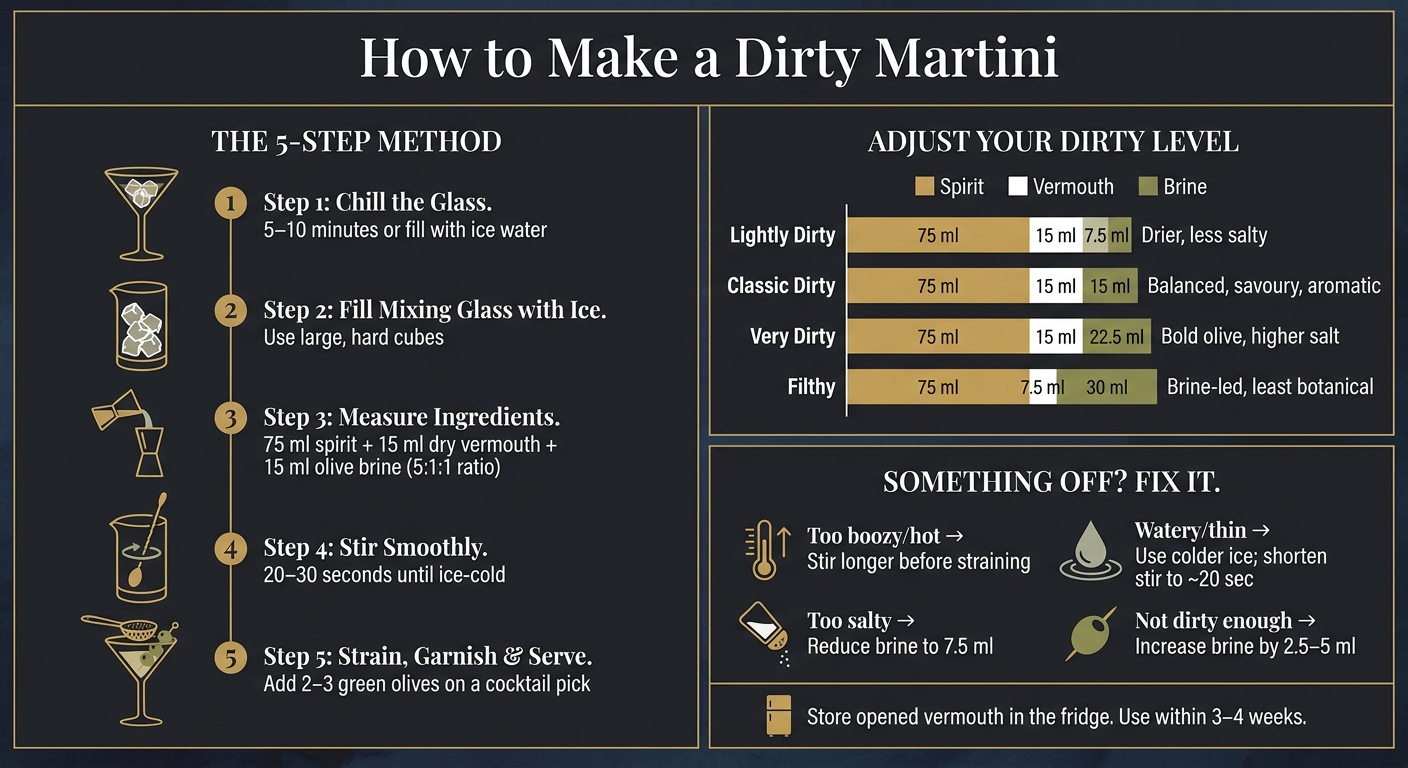
How to Make a Dirty Martini: Ratios, Steps & Troubleshooting
Recipe and step-by-step method
Once your glass is chilled and your ice is ready, the method is simple.
- Chill the glass. Empty the ice water and set the glass aside.
- Fill the mixing glass with ice.
- Measure in the ingredients. Start with the 5:1:1 ratio above, then fine-tune dilution with stirring. Add 75 ml gin or vodka, 15 ml dry vermouth and 15 ml olive brine. This is the 5:1:1 starting ratio. [5]
- Stir smoothly for 20–30 seconds. Stop when the mixing glass feels ice-cold. [1][2]
- Strain, garnish and serve. Pour through your strainer into the chilled glass, add two or three green olives on a cocktail pick and serve at once.
Stirring, dilution and common fixes
Stirring, not shaking, gives a Dirty Martini its clear look and silky texture. Shake it and you’ll cloud the drink and add too much water.
If something feels off, change one thing at a time: dilution, brine or vermouth. That makes it much easier to see what helped.
| Problem | Likely cause | What to do |
|---|---|---|
| Tastes hot or too boozy | Under-diluted | Stir for a little longer before straining |
| Tastes watery or thin | Ice too warm, stir too long | Use colder, harder ice; shorten the stir to around 20 seconds |
| Too salty | Brine too concentrated | Reduce brine to 7.5 ml next time |
| Not dirty enough | Brine too low | Increase brine by 2.5–5 ml |
For lighter or dirtier builds, use the ratio guide below.
Dirty Martini ratios from lightly dirty to very dirty
Ratio guide in ml for four styles
Start with the classic 5:1:1 build and change only the brine and vermouth to shift the drink from lightly dirty to filthy.
Use 75 ml gin or vodka as the base, then adjust the vermouth and brine.
| Style | Spirit | Asterley Bros English Dry Vermouth | Olive brine | Expected flavour |
|---|---|---|---|---|
| Lightly dirty | 75 ml | 15 ml | 7.5 ml | Spirit-forward, dry, light olive salt |
| Classic dirty | 75 ml | 15 ml | 15 ml | Balanced, savoury, aromatic |
| Very dirty | 75 ml | 15 ml | 22.5 ml | Bold olive flavour, higher salt |
| Filthy | 75 ml | 7.5 ml | 30 ml | Brine-led, least botanical |
The first three styles keep vermouth at 15 ml, so the only moving part is the brine.
Dirty, very dirty and filthy are loose labels, not fixed standards. [3][4][6] It is best to treat this table as a set of practical starting ratios rather than hard rules.
How to adjust one variable at a time
The simplest way to find your preferred ratio is to change one ingredient at a time, starting from the classic dirty build. Each part of the drink has its own job, and that makes tasting a lot easier.
Brine sets the level of salt and savoury depth. Move it up in 7.5 ml steps. That jump is easy to taste without tipping the drink too far in one go. [3][2][6] If the Martini starts tasting sharply salty rather than pleasantly savoury, pull the brine back before changing anything else.
Asterley Bros English Dry Vermouth shapes the dryness and the herbal edge. If the drink seems flat or a bit blunt, going back to the full 15 ml pour usually does more than adding extra brine. The vermouth should back up the olive note, not get lost behind it.
Gin or vodka shifts the whole feel of the drink. Gin gives you a more juniper-led, aromatic Martini that can stand up to heavier brine. Vodka is cleaner and more neutral, so the vermouth and brine sit further forward. If you switch from one to the other, keep the quantities the same at first. That way, you can taste what the base spirit alone is doing.
With your ratio sorted, the next decisions are the vermouth, garnish and final serve.
Best vermouth for a Dirty Martini, garnish choices and key takeaways
Our pick: Asterley Bros English Dry Vermouth
Once the base ratio is set, the vermouth decides how dry, aromatic and balanced the Martini feels.
Asterley Bros English Dry Vermouth is a strong fit for a Dirty Martini. Made with 28 botanicals on a base of English white wines, it brings a floral nose of rose, camomile and elderflower, with herbal notes of rosemary, thyme and sage that sit neatly with olive brine. That herbal edge helps a 15 ml pour stand up in gin and still come through in vodka. The citrus finish of lemon, orange and lime leaves keeps the drink clean rather than weighty. Use it within three to four weeks of opening.
Olive garnish and pairing examples
Once the vermouth is in place, the garnish shapes the final note.
Drain the olives before placing them in the glass, and strain the drink straight away so the olives do not water it down. Use brine-packed olives rather than oil-packed ones. Oil can cloud the drink and change the texture.
Olive choice changes the finish in a clear way. Larger, softer olives such as Castelvetrano or Nocellara give a rounder, softer result and suit a vodka-based Martini, where the vermouth comes through more clearly. Firmer, brinier olives bring a sharper savoury edge and work well in a very dirty serve. Always use clear brine. If there is visible sediment, strain it first, as cloudy brine can flatten both the look and the flavour.
For spirit pairing, gin with Asterley Bros English Dry Vermouth gives a more botanical, aromatic drink. Vodka is cleaner and more neutral, so the vermouth and brine move to the front. In both cases, start with the balanced base, then adjust the brine little by little.
Conclusion: the simplest way to balance a Dirty Martini
The main rule is simple: measure everything and change one thing at a time. Stir with plenty of cold ice until fully chilled, then strain at once into a chilled Martini or Nick & Nora glass. Add two or three green olives, taste, and only then decide if it needs more brine. Measuring, stirring, adjusting in small steps and storing the vermouth properly will make every Dirty Martini at home better.
FAQs
Can I make a Dirty Martini without vermouth?
Technically, yes, you can make one without vermouth, but it would not be a true Martini. Vermouth does a lot of the heavy lifting in the glass. It brings herbal bitterness, aroma and depth that soften the spirit and keep the olive brine in check.
If you have run out, dry sherry, dry white wine or sake can get you into similar territory. They will change the drink, though. For the best balance, reach for a good dry vermouth such as ASTERLEY BROS ENGLISH DRY VERMOUTH.
Which olives work best in a Dirty Martini?
Choose good olives if you want the drink to taste right. Castelvetrano is an easy all-round pick, with balanced brine and a savoury finish. Gordal goes in a bigger, meatier direction.
Cerignola and Nocellara both work well too. Whatever you buy, go for pitted olives. If you like, keep them in dry vermouth for up to a week so they take on more flavour.
How do I make a Dirty Martini less salty?
Use less olive brine. That is where the salt comes from, so cutting it back - or leaving it out altogether - keeps the drink from tipping too far into savoury territory. You will taste more of the gin’s botanicals and more of the herbal edge in the dry vermouth.
It also helps to choose a good olive brine. A clean, well-made brine brings salinity without bulldozing the drink.